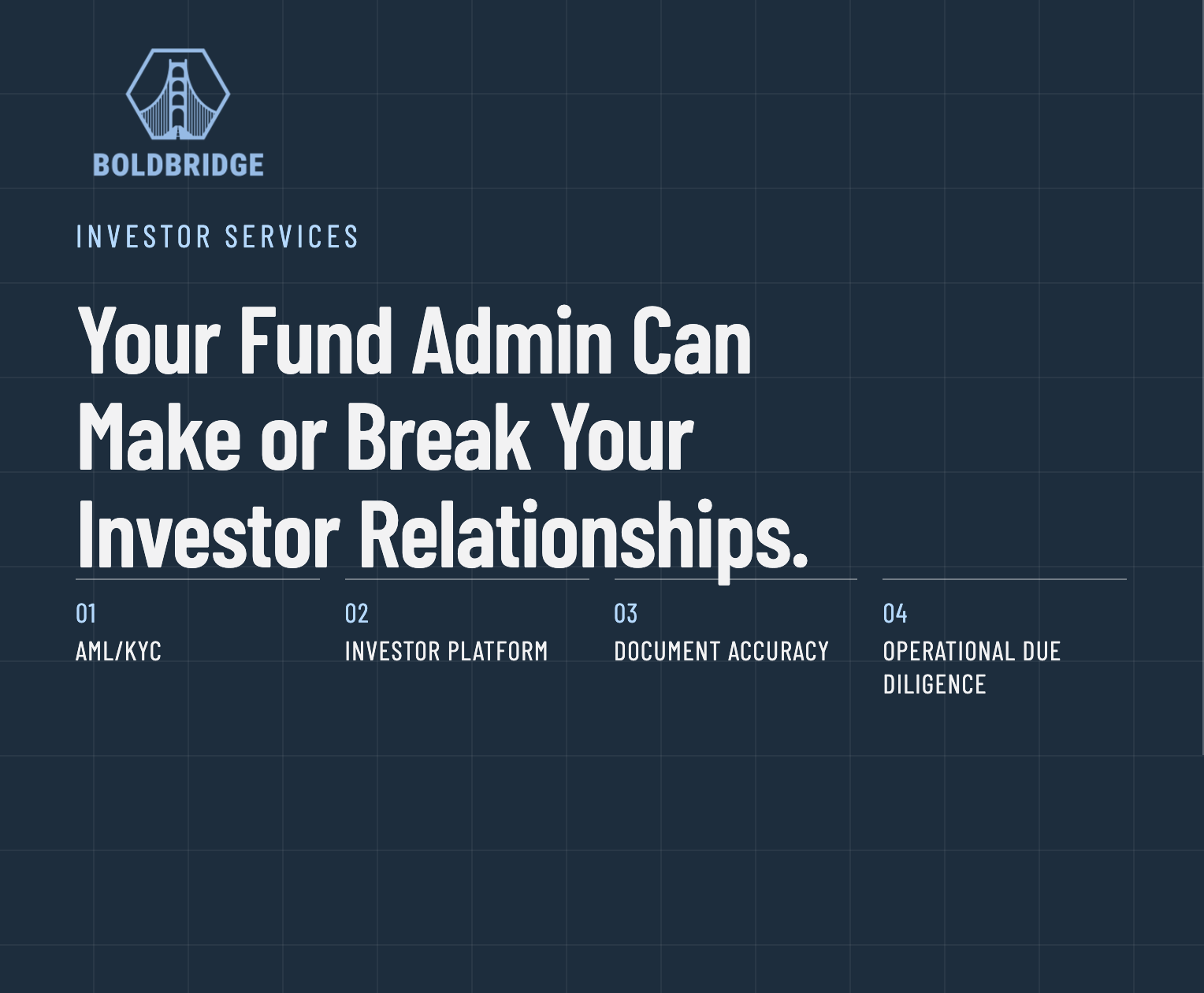
Your Fund Admin Can Make or Break Your Investor Relationships. Here's Why
Your Fund Admin isn't a back-office detail — it's the third party sitting between you and every investor relationship you've worked hard to build. From AML/KYC friction to platform selection to operational due diligence, here's where it can make or break your Investor Relations.
Good Controls Don’t Slow You Down. Bad Ones Do.
Controls have a bad reputation — dismissed as red tape that slows everyone down. But the right controls, done properly, speed delivery up. Five practical, real-world lessons on getting sign-off, fit, understanding, tools and consistency right in fund administration.
5 Areas Where AI Could Disrupt Fund Operations
AI has arrived, but do we really know where it will have the biggest impact on back-office fund operations? Speak to tech vendors and you may be led to believe that everything has already been figured out. Speak to the people doing the work, and you will hear a different story.
It is worth acknowledging the challenge of implementing AI and deciding where fund administrators and fund managers should focus first. This is not a typical technology enhancement. Because AI has such broad capabilities, it can be difficult to design a proof of concept, mainly because teams do not always agree on what concept they are trying to prove.
Pricing Private Market Fund Administration: Good Habits for CFOs and Fund Admins
Pricing a high-volume, low-commitment fund is one of the hardest calls in fund administration — the CFO wants budget certainty, the administrator wants to protect margin, and getting it wrong strains the relationship fast. Here's what good practice actually looks like on both sides of the table.
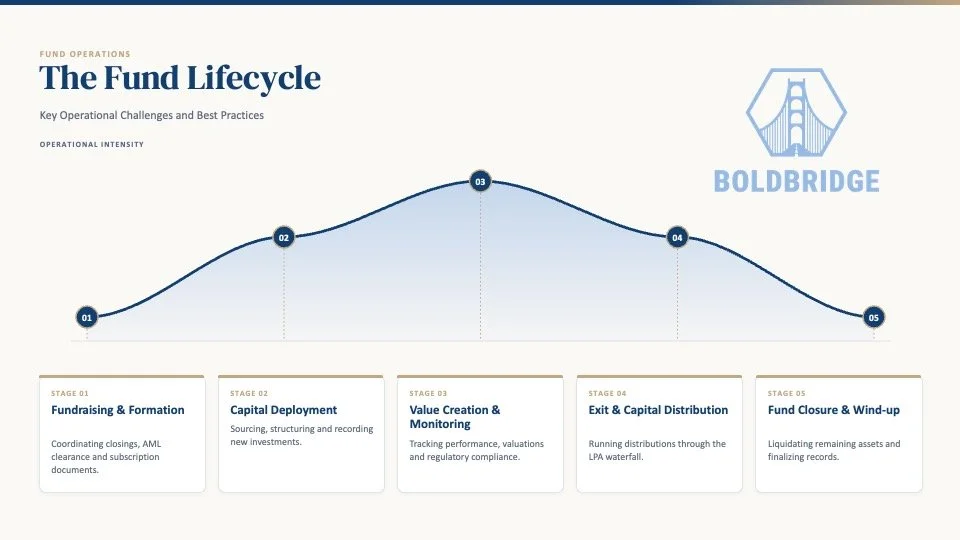
The Fund Lifecycle: Key Operational Challenges and Best Practices
From fundraising to fund closure, every stage of the Fund Lifecycle carries its own operational risk. This article walks through the five key stages — fundraising, capital deployment, value creation, exit, and wind-up — with the good-practice tips that keep Fund Managers, admins, and investors ahead of the operational hurdles that trip up even experienced teams.
What Is Corporate Governance, and Why Should Private Fund Managers Care?
What Is Corporate Governance, and Why Should Private Fund Managers Care?
Corporate governance is far more than compliance policies and regulatory checklists. For private fund managers, it is the framework that drives decision-making, risk management, accountability, and investor confidence. This article explores the practical role of governance within private fund structures, highlights the differences between UK and US governance models, and examines the key governance bodies that support institutional-quality fund management, including Boards, Investment Committees, LP Advisory Committees, General Counsel, and Corporate Secretaries. Ultimately, strong governance is not a burden but a strategic advantage that strengthens fundraising, improves operations, and helps protect long-term value.
Strategic Operational Timing: Why the Best Vendor Decisions Happen Long Before the Fundraise
The best vendor decisions happen 12–18 months before a raise, not during it. Here's how to get ahead of your next ODD review — before it finds you first.
Choosing the Wrong Fund Admin Costs Time and Money. So How Do You Choose the Right One? Is there a clear winner?
Choosing the wrong fund administrator doesn’t just cause operational friction—it costs serious time, capital, and LP confidence.
Whether you are launching a greenfield strategy or scaling an established multi-fund platform, selecting an administrative partner is one of the most consequential decisions a fund manager makes. Yet, in a market flooded with generic vendor claims, managers across every asset class and AUM threshold regularly fall into the same traps: overpaying for enterprise overhead they don't use, or partnering with a mid-market provider that lacks specialized asset-class capabilities.
In this article, we break down the five core pillars of fund admin selection—Scale, Cost, Technology, Asset-Class Specifics, and Operating Models—so fund managers at any stage can cut through vendor marketing, prevent costly service migrations, and align with a partner built for their specific operational model.
Freeing Up Your Operating Partner: How Fund Admin Talent Can Extend the Value Creation Team
Why your Operational Strategy Matters
Why your operational strategy matters. Selecting the wrong software platform or third-party administrator today can bottleneck your subsequent fund launches tomorrow. This article explores how your operational framework directly impacts your cost structure, technology stack, compliance footprint, and investor relations—giving you a clear roadmap to get your infrastructure right from day one.
How to Avoid Operational Debt: A Guide for Growing Venture Capital Funds