

The Fund Lifecycle: Key Operational Challenges and Best Practices
Operational challenges exist at every stage throughout a Fund Lifecycle. These are a few of the operational challenges to look out for, and how a service provider can help.
1. Fundraising and formation
The first stage in a Fund Lifecycle is the fundraising and the Fund formation period. During this period, the PPM, LPA and subscription documents are drafted which contain details of how the Fund will operate, the investments that will be targeted and basic structural matters. The coordination of Fund closings, tracking of Side Letter terms, Investor AML clearance and Subscription Document completion execution are key at this stage.
This stage of the Fund Lifecycle takes a real coordinated effort. Fund Manager Partners and Investor Relations teams work tirelessly to market the Fund to target investors, legal teams work to keep up with potential investor demands and side letter agreements and admin teams work to coordinate AML sign-off and subscription document collation. Considering the amount of work that happens before the GP meeting to approve new investor subscriptions, Legal and Investor Relations teams can be forgiven for thinking that the closing is taken care of, however caution should be taken as a delayed AML sign-off or an incomplete subscription agreement can present additional operational risks to the fund. Following the closing meeting, issuing a capital call notice is the next operational hurdle, with subsequent closings requiring equalization and a unique, one-time process to be followed.
Good practice tip: your service provider should maintain a tracker of investor onboarding, and regular check-in calls should be held between the Fund Manager, Investor Relations, Legal and Compliance teams and the service providers responsible for AML and Capital Calls (if serviced in house, this is your finance team).
2. Capital Deployment
Once the Fund has raised capital, it’s time to get to work putting the money to good use. The Front-Office deal teams take the lead here, sourcing appropriate deals in line with the investment strategy of the fund. The Back-Office team becomes involved when investments are presented to and approved by the Investment Committee. The accounting and admin teams are responsible for processing the capital calls to satisfy the investment, recognizing the investment in the financial records and tracking its performance. Once the money has flowed from the Fund and the investment is completed, the Front-Office takes a lead role in monitoring the performance of the portfolio company and executing on value creation strategies. Ensuring the investments are accurately tracked by the accounting teams is key to ensuring the financial records are updated and regulatory reports like Form PF or AIFMD are accurate.
Good practice tip: the completion of investments should be a coordinated effort. The most efficient Fund Managers I have seen have a Transactions Lead who coordinates the investment completion. This includes establishing the SPVs and HoldCos, coordinating the flow of funds and ensuring any ongoing obligations are documented. This can be a heavy lift though, and they should be supported by service providers or internal admin teams.
3. Value Creation and Monitoring
Front office investment teams monitor the investment performance as part of their portfolio monitoring and work with value creation teams and the finance teams to monitor performance and execute on value creation strategies. Back-office teams support by tracking the investment performance and preparing the investor reports. The Compliance and Legal teams also play an important role here, ensuring that the structures are compliant with relevant laws and tax requirements. Valuation of investments is also a key operational consideration, as it influences reporting, investor communications and decision making throughout the Fund Lifecycle. Funds will need to consider ASC 820/IFRS 13 disclosure requirements, and the valuation committee processes in reviewing the valuation methodology. Some investors will also demand external valuation reviews.
Good practice tip: For active Funds, the information bottlenecks can occur, and there can be delays in accounting teams receiving important information. When this happens, the accounting team can spend significant amounts of time reconciling transactions to ensure investments are accurately recorded. On occasion this is caught by the auditor, and the time taken to investigate and remediate can delay reporting timelines and delay the delivery of reports to investors and regulators – two key stakeholders. Share the funds flow document with the accountants shortly after closing so they can see which entities are paying money, and which entities are owning assets. They can track things a lot easier using the funds flow.
4. Exit and Capital Distribution
Again, the Front office investment teams take the lead on coordinating exits in line with the targeted investment plans. Once the exits are confirmed, the Back-Office team will track the receipt of funds and run proceeds through the waterfall model. The Waterfall Model is a calculation ensuring that returns are distributed in accordance with LPA waterfall provisions. Typically, LPs receive a return of contributed capital followed by a preferred return where applicable, after which carried interest is allocated in accordance with the waterfall provisions of the LPA.
Good practice tip: Waterfall models can be very complex and there are relatively few system solutions that can fully accommodate bespoke waterfall provisions agreed in an LPA. If the waterfall model is wrong, and funds are sent to the wrong parties at the wrong time, the Fund will need to coordinate a return of funds and will need to redistribute. This is an incredibly arduous process, and it goes without saying, it can be damaging to investor relationships. Ensure waterfall models are updated regularly and ensure that internal mock audits are a part of the culture of the organization. Catching an error before it reaches your investors is far less damaging. And ensuring returns go off without a hitch is a great look – especially when you start raising for the next fund!
5. Fund closure and winding up process
As the Fund reaches the end of its term, the remaining investments should be liquidated with returns distributed to investors. The accountants will need to finalize financial records. Tax advisors and legal teams take a lead role in ensuring legal and tax compliance throughout the process and that contractual obligations are fulfilled. Once funds are returned, this becomes an exercise of tying off loose ends, ensuring companies are dissolved, records updated and stakeholders receive appropriate communications.
Good practice tip: Again, the Transactions Manager is key at this step as they effectively coordinate the operations teams to close out the Fund operations and realize remaining investments.
Fund closure can be drawn out if funds are not accurately tracked, creditors are not paid and if the accountants need to spend a lot of time reconciling the books and records to find out what happened. Ensure the closing process is project managed and clear, concise and effective communications flow through the operations teams. This will speed up the closing process and should minimize errors.
The traditional Fund Lifecycle is a well-trodden path and assumes standard practice. In modern times, however, funds are holding onto assets for longer as return multiples have not been hit, investor capital can remain locked up for longer periods whilst waiting for realizations, with some aging vehicles being labelled "zombie funds" in the media. Some funds are selling assets to themselves in the form of continuation funds, creating additional operational complexity and extending reporting and governance requirements.
In conclusion, the Fund Lifecycle perfectly articulates the coordination and internal communication requirements of a fund, from the Front-Office investment teams to the Back-Office operational teams. Communication, organization and clear responsibilities are key to successful funds.
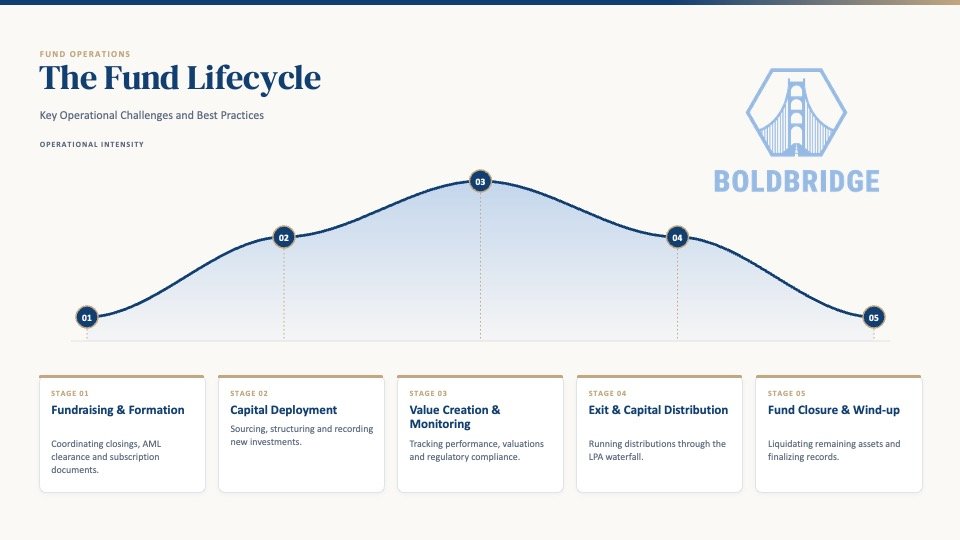
Operational Challenges Through The Fund Lifecycle