What Is Corporate Governance, and Why Should Private Fund Managers Care?
Every service provider claims to improve it, every due diligence questionnaire asks about it, and every institutional investor says it matters. Yet ask ten people to define corporate governance and you'll likely receive ten different answers.
The reality is that governance is not just a compliance exercise or a collection of policies sitting on a shared drive. Done properly, it is the operating framework that supports decision-making, manages risk, and creates investor confidence. For private fund managers, strong governance is increasingly a competitive advantage. It extends way beyond the ‘we write policies and procedures’ or ‘we ensure compliance’ tone that you often hear at conferences. It seeps into the bones of the organization and influences how effectively a business makes decisions, allocates capital, manages risk, and executes its strategy.
So, what is corporate governance? The Cadbury Report (1992) defines corporate governance as "the system by which companies are directed and controlled." It is a simple definition on the surface, but deceptively broad in practice.
Governance encompasses the structures, processes, relationships, and behaviors that determine how an organization makes decisions, allocates authority, manages risk, and holds people accountable. It influences everything from strategic oversight and capital allocation to culture, ethics, and operational discipline.
This is why governance should not be confused with compliance. Compliance is one component of governance. Governance is the framework that shapes how the entire organization operates.
UK vs US Definition
This is where the UK and US genuinely diverge, and it's a distinction worth being precise about. In the UK, corporate governance for listed companies runs through a public, principles-based Code, enforced on a ‘comply or explain’ basis — a company either follows it, or publicly justifies why it hasn't. US private funds have no equivalent public code to point to. Governance instead gets built contractually, through the Limited Partnership Agreement (LPA) and side letters negotiated privately between the Fund Manager and its investors. The underlying principles — accountability, transparency, sound decision-making — are similar. The difference lies in how those principles are enforced: through a public code and regulatory expectations in the UK, versus contractual arrangements negotiated directly with investors in the US.
Having spent my career working across both systems — trained in UK governance principles through the Chartered Governance Institute, and applying them inside US fund structures for the better part of a decade — this is the gap I spend most of my time bridging: taking governance principles built for a public, code-driven environment, and translating them into something that actually works inside a privately negotiated, contract-driven US fund.
Governance in US Private Funds
Private funds may not be legally required to comply with a formal corporate governance code, but institutional investors increasingly expect governance frameworks that demonstrate the same level of rigor, accountability, and oversight found in well-governed public companies.
During operational due diligence, LPs are not simply assessing investment performance. They are evaluating whether the manager has the processes, controls, oversight, and decision-making framework necessary to protect investor capital.
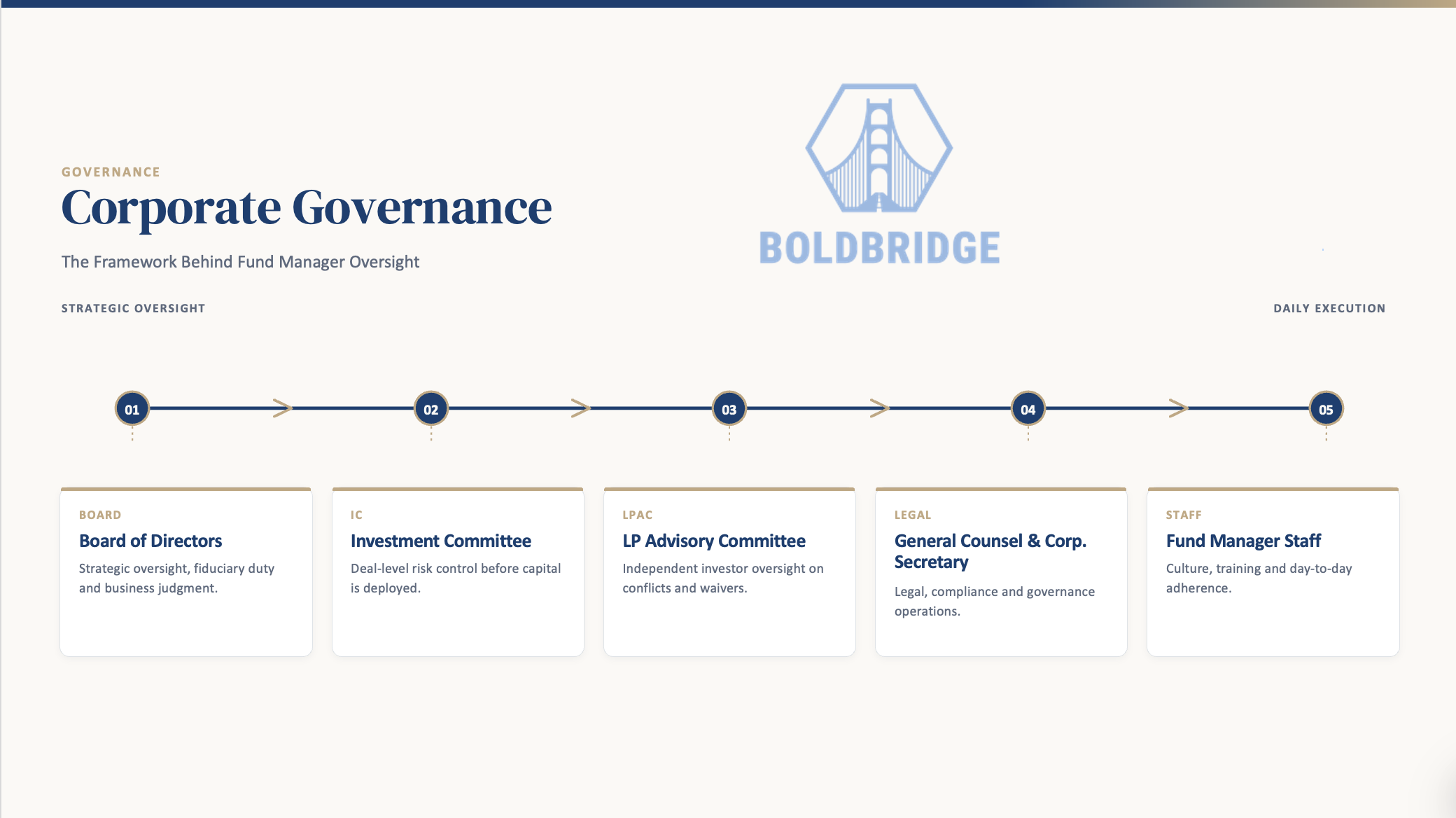
In practice, governance within a private fund manager is delivered through a series of interconnected bodies and functions, each with distinct responsibilities. While structures vary from manager to manager, most institutional-quality firms will have some variation of the framework below.
For private fund managers, governance matters for three reasons:
It reduces operational and key-person risk.
It improves credibility with institutional investors during due diligence.
It creates a scalable decision-making framework as the business grows.
In a crowded fundraising market, investors increasingly view governance as a proxy for organizational quality. Strong governance signals that a manager can responsibly steward capital through both good markets and bad.
Board of Directors
The Board is made up of key executives within the Fund Manager, and experienced non-executive directors not employed by the Fund Manager. The Board is ultimately responsible for the direction, oversight, and stewardship of the Fund Manager, operating in accordance with the company's governing documents and fiduciary obligations. Under US corporate law, directors owe two core fiduciary duties: a duty of care and a duty of loyalty (which includes acting in good faith). Provided directors meet these duties — acting on an informed basis, in good faith, and without a conflicting interest — courts will generally not second-guess their business decisions, a standard of protection known as the business judgment rule. Their core responsibilities are to set and execute the business strategy, maintain financial oversight of the business, and ensure risk management and compliance with applicable law. They are usually guided by a Corporate Secretary or Corporate Governance Professional to ensure their compliance and to ensure all records and decisions are properly noted.
Investment Committee
The Investment Committee (IC) is the primary investment decision-making body within the organization and serves as a critical risk-control mechanism, ensuring investment opportunities are challenged, debated, and evaluated consistently before capital is deployed.
Typically comprised of executives, experienced non-executives, and senior business leaders, the IC has authority to approve, reject, and manage investments on behalf of the fund. Its composition and authority are generally set out in the fund's governing and marketing documents and may differ from fund to fund.
As the make-up of the IC can differ per fund, the Board usually delegates its decision-making power to the IC for each fund. Deal teams compile detailed IC memos documenting their investment proposal, the risks, mitigations, and the plan to achieve target returns. The IC also approves potential exits and follow-on investments.
LPAC
Most Fund Managers appoint an LP Advisory Committee (LPAC), a committee made up of LPs and key executives. The LPAC provides an important layer of investor oversight, helping managers navigate conflicts while giving LPs confidence that key decisions are subject to independent review. Common responsibilities include resolving conflicts of interest, approving waivers of key LPA provisions proposed by the Board, and approving extensions to the fund's investment period.
General Counsel
The General Counsel is the firm's senior legal adviser, responsible for overseeing legal, compliance, regulatory, and governance matters across the business. They play a lead role in fund formation, regulatory compliance, transaction support, investor negotiations, and side letter management. They will also handle all outside Legal liaison.
The Corporate Secretary
Sitting within the General Counsel's team, the Corporate Secretary acts as the operational backbone of the governance framework, ensuring that decision-making is properly documented, actions are tracked, and leaders have the information required to make informed decisions. They call meetings, manage the meeting schedule, ensure proper proceedings during those meetings, and handle post-meeting record keeping and action tracking. They also play a key role in communicating Board decisions and ensuring alignment across the wider organization. They are both a compliance function and a business leader. During times of dysfunction, the Corporate Secretary is uniquely and independently positioned to offer executive coaching and help resolve disputes as they arise.
Fund Manager Staff
Finally, the staff of the Fund Manager have their own role to play in Corporate Governance — adhering to policies and procedures once properly trained on them, and avoiding unnecessary risk. As the heartbeat of the organization, they also play a lead role in maintaining the culture of the business.
Conclusion
Governance isn't a compliance checkbox, and it isn't something you bolt on once an LP asks for it. As the list above shows, it touches nearly every layer of how a Fund Manager operates — from how the Board makes decisions, right down to whether the newest analyst has been trained on the policy they're expected to follow.
Ultimately, governance is not about producing more paperwork. It is about creating an organization that investors trust, employees understand, and leaders can manage effectively.
The strongest fund managers rarely view governance as a burden. They see it as infrastructure: something that enables better decisions, stronger fundraising outcomes, smoother operations, and sustainable growth.
Governance may not generate returns on its own, but poor governance can destroy value remarkably quickly.
Where Boldbridge Can Help
Whether you are preparing for institutional fundraising, reviewing your governance framework, or simply want confidence that your Board and IC processes would withstand investor scrutiny, it's worth a conversation.
Boldbridge offers a Governance Health Check to benchmark where you stand today and can help build out anything from board pack processes to a full advisory board from the ground up.
Governance issues are always easier to fix before they appear in a due diligence report. Get in touch to identify the gaps before your next institutional investor does.